Executive summary
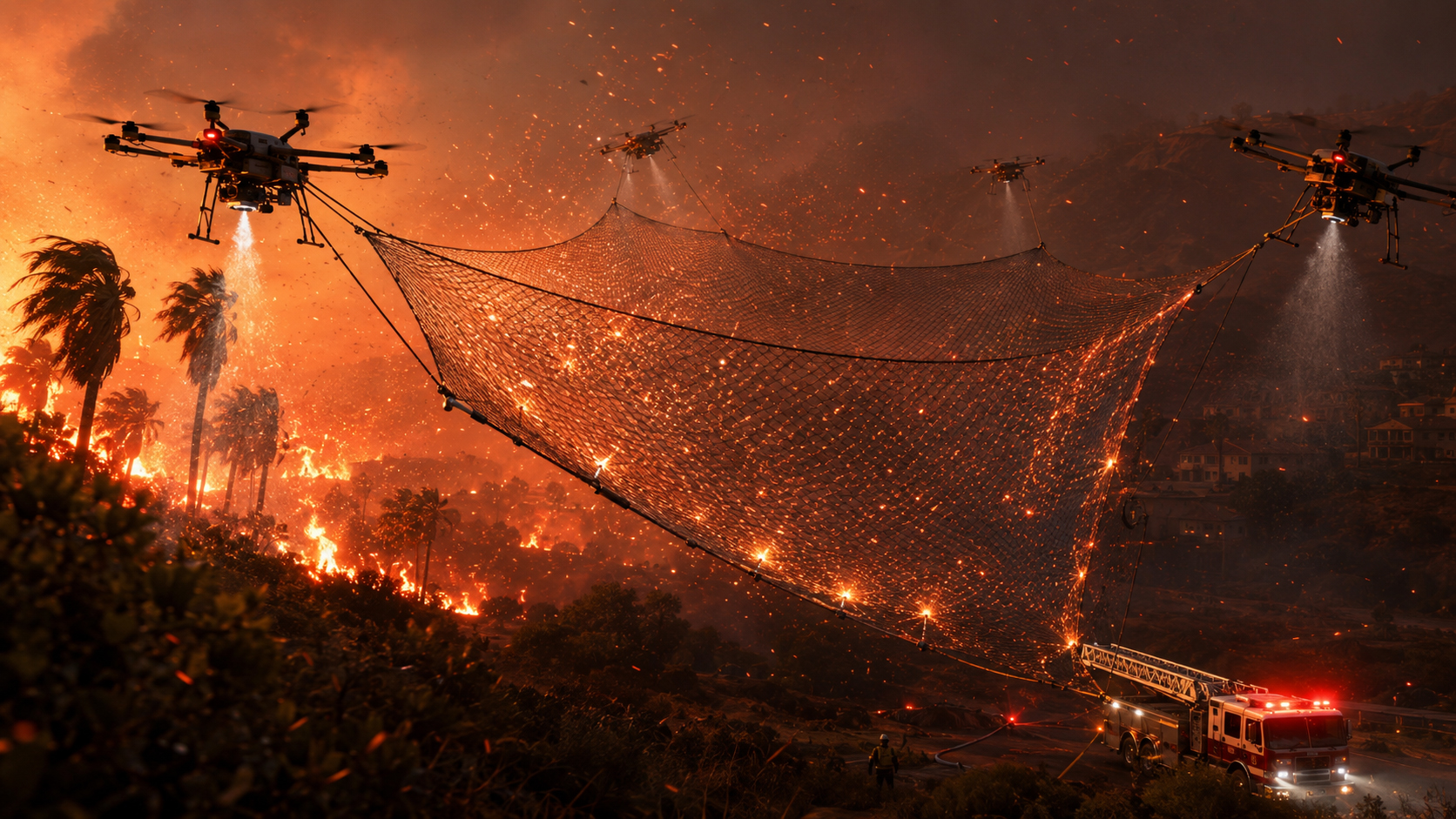
Firenetting is an airborne ember-interception concept.
Wildfire spread is often accelerated by windborne embers that travel ahead of the
visible flame front and ignite new fuel sources. Firenetting addresses this gap by
proposing an airborne interception layer: UAV-controlled fire-resistant mesh netting
positioned between ember sources and vulnerable targets.
Brief status: Firenetting is currently a patented concept seeking prototype funding,
engineering validation, controlled testing, and field demonstration partners.
This brief is designed for grant reviewers, strategic investors, wildfire researchers,
drone-platform partners, and public-safety agencies.
Open the full white paper
for printing, saving as PDF, or distribution.
The core system is protected by U.S. Patent No. 12,539,435 B2,
titled “Unmanned Aerial Vehicle (UAV) Controlled Netting System and Method Thereof.”
The next step is not invention. The next step is engineering validation.
Funding objective: move Firenetting from patented concept to prototype, simulation,
controlled testing, field demonstration, and commercialization pathway.
Founder credibility
Built by a field-energy inventor, not a theory shop.
Bradley Bartz is the inventor of FRED and founder of
ABC Solar Incorporated. His background brings decades of practical
solar, battery, backup power, field installation, and emergency-resilience experience
into the wildfire technology problem.
Firenetting connects protected intellectual property with practical deployment questions:
lift capacity, battery power, tethered power, fire-truck support, field safety, and
real-world emergency operations.
Problem
Embers defeat ordinary boundaries.
Firebreaks, roads, defensible space, and structure hardening are important, but
windborne embers can cross gaps, land on receptive fuel, enter vulnerable openings,
ignite vegetation, and create new fire starts. Once embers land, response becomes
more difficult, more dangerous, and more expensive.
Firenetting focuses on the moment before ignition: intercept the ember while it is
still airborne.
Invention
FRED: First Responder Ember Drone.
FRED combines battery-powered UAVs, fire-resistant mesh netting, positioning control,
ember-source awareness, wind-condition response, and optional water or fire-retardant
delivery. The patented concept includes multiple deployment modes, including:
- Single-UAV parachute-style mesh netting for targeted ember interception.
- Multi-UAV rectangular ember barriers for larger airspace coverage.
- Fire-truck-supported tethered operations with ground power and water supply.
- Roadway, firebreak, property, palm-tree, and infrastructure protection scenarios.
Prototype path
Build, test, measure, then scale.
A responsible development program should begin with modeling and small-scale
engineering tests before moving into controlled burn environments and observed
field demonstrations.
-
Engineering study: mesh material, net porosity, wind-load modeling,
ember-size assumptions, UAV lift requirements, tethering, and safety protocols.
-
Small-scale prototype: controlled fan testing, safe ember analogs,
mesh capture measurements, tether behavior, and drone handling evaluation.
-
Controlled fire lab testing: fire-resistant net behavior, ember
capture rate, heat exposure, water/retardant spray, and operational procedures.
-
Field demonstration: agency-observed test in a realistic but
controlled scenario, such as a roadway/firebreak, property perimeter, or palm-tree hazard.
Preliminary budget range
A staged budget keeps the risk controlled.
The following ranges are preliminary planning estimates intended to support grant,
investor, and partner conversations. Final budgets should be refined after engineering
scoping, partner selection, UAV platform review, and test-site planning.
| Phase |
Purpose |
Estimated Budget |
| Phase 1 |
Engineering study, simulation, safety review, material evaluation, and prototype specifications. |
$75,000–$150,000 |
| Phase 2 |
Small-scale prototype, wind/fan testing, safe ember analog testing, and capture-rate measurement. |
$150,000–$300,000 |
| Phase 3 |
Controlled fire lab testing, suppression-at-net testing, thermal exposure, and revised prototype design. |
$300,000–$750,000 |
| Phase 4 |
Agency-observed field demonstration, documentation, partner review, and commercialization roadmap. |
$750,000–$1,500,000 |
Proposed 12-month timeline
Move quickly, but measure everything.
A 12-month development path can produce a serious engineering record, a tested
prototype, and an agency-observed demonstration plan.
Months 1–2
Engineering design, partner selection, test objectives, safety review, and initial material screening.
Months 3–4
Mesh/UAV modeling, wind-load analysis, prototype specifications, and tethered power/spray system review.
Months 5–6
Small-scale prototype fabrication, fan testing, safe ember analog trials, and capture-rate measurement.
Months 7–8
Controlled ember/fire-lab testing, thermal exposure review, suppression-at-net testing, and data logging.
Months 9–10
Revised prototype design, operational safety documentation, fire-agency review, and field-demonstration planning.
Months 11–12
Agency-observed demonstration, technical report, commercialization roadmap, and next-stage funding package.
Research questions
The grant should answer hard questions.
| Question |
Why it matters |
| What mesh porosity captures dangerous embers without becoming an uncontrollable sail? |
Determines net design, wind loading, and practical operating range. |
| What UAV lift capacity is required for useful net sizes? |
Determines drone platform, payload, battery, and tether requirements. |
| Can tethered power extend operating time safely? |
Determines whether fire-truck or ground-station support is preferred. |
| How effective is spray suppression at the net? |
Determines whether captured embers can be cooled or extinguished before landing. |
| Which first deployment scenario is most practical? |
Focuses development on the highest-value early use case. |
Use of funds
Funding turns the patent into evidence.
Grant and investment funding would be used to produce measurable engineering results,
not just promotional materials.
- Engineering design and safety review.
- Computational modeling and wind-load simulation.
- Fire-resistant mesh material research and fabrication.
- UAV platform evaluation and lift testing.
- Prototype construction and test instrumentation.
- Controlled ember-capture testing and documentation.
- Fire agency, utility, insurance, and research partner engagement.
- Commercialization, licensing, and manufacturing planning.
Candidate partners
This requires a serious test coalition.
Firenetting is seeking conversations with fire agencies, emergency management
leaders, universities, wildfire research labs, drone manufacturers, utilities,
insurers, fire-resistant material suppliers, climate resilience funders, and
strategic investors.
The correct first partnership is one that can help define the safest, most measurable,
and most fundable prototype test.
Conclusion
A new layer, not a replacement.
Firenetting does not claim to replace existing wildfire suppression. It proposes
a new layer: airborne ember interception. The patent exists. The need is urgent.
The next step is to build, test, measure, and determine where this technology can
responsibly protect lives, property, and infrastructure.